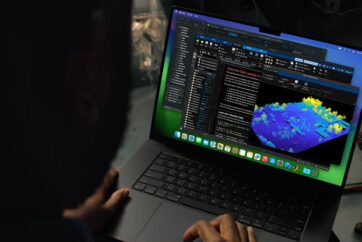
Apple has introduced two new Mac chips, M6 and M5 Ultra, bringing major performance upgrades to the new Mac mini and Mac Studio with a strong focus on on-device AI.
The new M6 chip, debuting in the latest Mac mini, is Apple’s first chip built using a 2nm process, making it a major step forward for Apple silicon. The chip features a larger 12-core CPU, a 12-core GPU, Neural Accelerators in each GPU core, and a new Dual 16-core Neural Engine designed to make AI tasks faster and more efficient.
Apple says M6 delivers the world’s fastest single-threaded CPU performance, with up to 1.2x faster multithreaded performance compared with M5 and up to 2.4x faster performance compared with M1. The chip also supports up to 32GB of unified memory and up to 170GB/s of memory bandwidth, helping with multitasking, local AI models, development work, and creative apps.
The GPU has also been upgraded with hardware-accelerated ray tracing, updated Dynamic Caching, improved shader architecture, and 50% higher geometry rates, making the chip more capable for games, 3D work, and graphics-heavy apps.
For AI, M6 brings a notable jump. Apple says the chip delivers nearly 30% higher peak GPU compute for AI compared with M5 and more than 8x higher AI compute compared with M1. The Dual 16-core Neural Engine also allows system frameworks to use both engines together for faster model execution.
Alongside M6, Apple also introduced M5 Ultra, the company’s most powerful chip to date. The chip debuts in the new Mac Studio and is aimed at professional users working with large AI models, high-end video, scientific analysis, visual effects, 3D rendering, and other demanding workflows.
M5 Ultra uses a new quad-die architecture for the first time in an Apple M-series chip. Apple says the chip connects two dual-die M5 Max chips using next-generation UltraFusion technology, allowing the four dies to behave as one unified processor.
The chip features up to a 36-core CPU, up to an 80-core GPU, a 32-core Neural Engine, and up to 512GB of unified memory. Memory bandwidth reaches 1.2TB/s, which Apple says is 50% higher than M3 Ultra.
That level of memory is especially important for AI work, allowing users to run huge local models entirely on-device instead of relying on cloud services. Apple says M5 Ultra can support large language models with hundreds of billions of parameters, while keeping data local and private.
M5 Ultra also brings Neural Accelerators to each GPU core, giving the chip up to 4.5x higher peak GPU compute for AI compared with M3 Ultra and more than 6x compared with M1 Ultra. Graphics performance is also up to 40% faster than M3 Ultra, with hardware-accelerated mesh shading, third-generation ray tracing, and second-generation Dynamic Caching.
Apple has also upgraded the Media Engine in M5 Ultra, with hardware acceleration for H.264, HEVC, ProRes, and AV1 decode, making the chip particularly suited to high-resolution video editing and professional media workflows.
The new chips are also designed to work closely with Apple’s developer tools, including Core AI, Core ML, Metal, and Xcode, allowing developers to build, run, and fine-tune AI models locally on Mac.
The launch of M6 and M5 Ultra marks another major step in Apple’s push toward on-device AI, with both chips designed to power the next generation of Apple Intelligence, Siri AI, and more advanced local computing workflows across the Mac.